
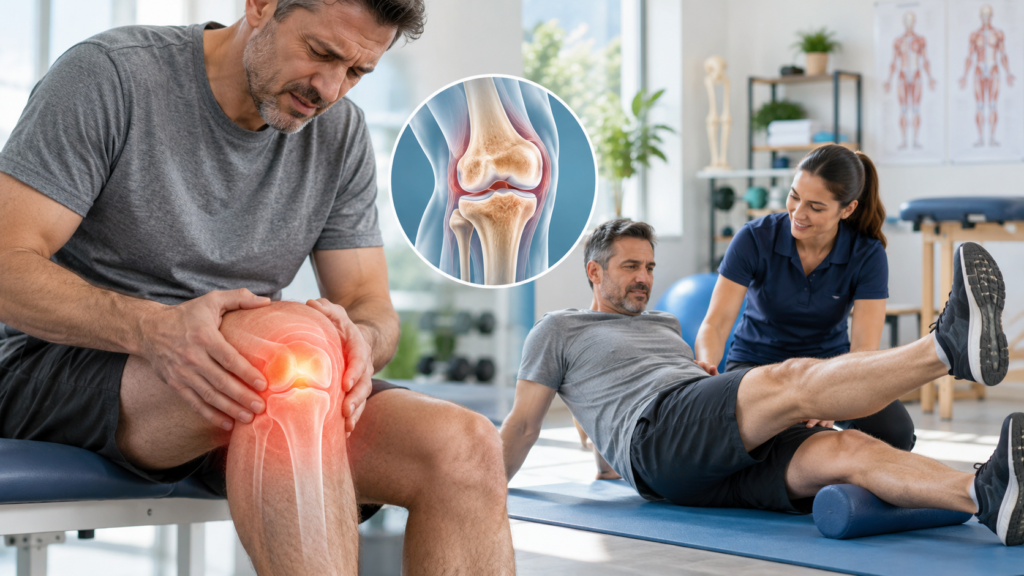
Most knee pain comes from overuse, weak or tight muscles around the knee and hip, minor sprains, or early osteoarthritis. It often improves with simple strengthening exercises, activity changes and physiotherapy. See a doctor urgently if your knee is hot, red, badly swollen, gives way, or you cannot put weight on it.
Your knees carry you through every step, stair and squat, so when they hurt, everything gets harder. Kneeling in the garden, climbing stairs at work, or chasing the kids at the park can suddenly feel like a challenge.
The good news: most knee pain responds well to the right exercises and guidance. This guide covers the most common causes, six exercises our physiotherapists use every day, and the signs that it is time for professional help. When you need hands-on care, our team offers physiotherapy in Brampton for knee pain at every age and activity level.
What Causes Knee Pain? The 6 Most Common Reasons
Cause | Typical signs | Who it often affects |
Patellofemoral pain (runner’s knee) | Ache around or behind the kneecap, worse on stairs, squats or after sitting | Runners, teens, active adults |
Knee osteoarthritis | Stiffness in the morning, aching with activity, swelling, creaking | Adults over 45 |
Patellar tendinopathy (jumper’s knee) | Pain just below the kneecap when jumping or climbing stairs | Basketball and volleyball players, runners |
Ligament sprain (MCL, ACL) | Pain after a twist or impact, swelling, a feeling of instability | Soccer, skiing and contact sports players |
Meniscus tear | Catching, locking or clicking, pain when twisting or squatting | Athletes and adults 40+ |
Bursitis | Swelling and tenderness over the front or inside of the knee | People who kneel often, such as tradespeople and cleaners |
Learn more about how we treat arthritis, tendonitis, bursitis and running injuries.
Why the knee often isn’t the real problem: weak hip and thigh muscles, stiff ankles or flat feet can change how force travels through your knee. That is why a good physiotherapist assesses your hips, ankles and walking pattern, not just the sore spot.
When Should You See a Doctor or Physiotherapist for Knee Pain?
Get urgent medical care if you:
- Cannot put any weight on your leg
- Have a knee that looks deformed after an injury
- Have a hot, red, swollen knee with a fever
- Heard a loud pop with immediate swelling
Book a physiotherapist if:
- Pain lasts longer than one to two weeks
- Your knee clicks, catches or feels unstable
- Pain stops you from walking, running, kneeling or using stairs comfortably
- Swelling keeps coming back after activity
- You want to return to sport safely after an injury
You do not need a doctor’s referral to see a physiotherapist in Ontario.
6 Physio-Approved Exercises for Knee Pain
These gentle exercises build strength around the knee and hip. Do them once a day, three to five days a week. Mild discomfort (up to 3 out of 10) is okay; sharp pain is not. Stop and get assessed if pain gets worse.
Developer note: add a photo or short video of the physiotherapist demonstrating each exercise.
1. Quad Sets Sit with your leg straight and a rolled towel under your knee. Tighten the muscle on the front of your thigh to press the knee into the towel. Hold 5 seconds. 10 reps. Why it helps: wakes up the quadriceps, which protect the knee joint.
2. Straight Leg Raises Lie on your back with one knee bent. Keep the other leg straight, tighten your thigh and lift it to the height of the bent knee. Lower slowly. 2 sets of 10. Why it helps: strengthens the thigh without bending a sore knee.
3. Glute Bridges Lie on your back, knees bent and feet flat. Squeeze your buttocks and lift your hips until your body forms a straight line from shoulders to knees. Hold 3 seconds. 2 sets of 10. Why it helps: strong glutes reduce strain on the knee when you walk, run and climb stairs.
4. Side-Lying Leg Raises (Clamshells as an alternative) Lie on your side with your bottom knee bent. Keep your top leg straight and lift it about 30 cm, leading with the heel. Lower slowly. 2 sets of 10 each side. Why it helps: strengthens the hip muscles that keep your knee lined up.
5. Wall Sits (Shallow) Stand with your back against a wall, feet hip-width apart, about 30 cm from the wall. Slide down until your knees are slightly bent (no lower than 45°). Hold 10 to 30 seconds. 3 reps. Why it helps: builds quadriceps strength in a controlled, knee-friendly position.
6. Calf Raises Stand holding a counter. Rise onto your toes, pause, then lower slowly. 2 sets of 15. Why it helps: strong calves absorb impact and support the knee when walking and running.
Tip: for long-standing knee pain or arthritis, walking, cycling and swimming are excellent low-impact ways to stay active. If flat feet or your walking pattern contribute to your pain, custom orthotics may help.
How Physiotherapy Treats Knee Pain
Exercises are a great start, but a physiotherapist finds out why your knee hurts and builds a plan around it. Treatment may include:
- A full assessment of your knee, hips, ankles, posture and how you walk, squat and climb stairs
- Manual therapy to reduce stiffness and improve knee movement
- A progressive strengthening program tailored to your sport, work and goals
- Taping or bracing for short-term support
- Acupuncture to help with pain, where appropriate
- Return-to-sport testing with sports physiotherapy after injury
Many people with common knee problems notice improvement within four to eight weeks of consistent physiotherapy. Not sure what happens at the first appointment? Read what to expect at your first physiotherapy visit.
Get Knee Pain Relief at Our Physiotherapy Clinic in Brampton
Don’t let knee pain decide what you can and cannot do. Our registered physiotherapist will assess your knee, explain what is going on and build a plan to get you moving comfortably again. Visit our physiotherapy clinic in Brampton at 9300 Goreway Dr, open six days a week.
Knee pain holding you back? Book a physiotherapy assessment at Ignite Health Clinic, 9300 Goreway Dr, Unit B-102, Brampton. Call (647) 553-8383 or book online.
Knee Pain FAQ
What is the fastest way to relieve knee pain?
For a new flare-up, reduce the activity that aggravates it, use ice for 15 minutes a few times a day, and keep the knee moving gently. Lasting relief usually comes from strengthening the thigh and hip muscles. A physiotherapist can speed this up with hands-on treatment and a tailored plan.
Should I walk with knee pain?
In most cases, yes. Gentle walking keeps the joint mobile and the muscles strong, especially with arthritis. Keep the pace comfortable and shorten the distance if pain rises above a mild ache. Do not walk on a knee you cannot put weight on; see a doctor first.
Is it better to use heat or ice for knee pain?
Use ice for new injuries or swelling, usually in the first 48 to 72 hours. Use heat for stiffness and long-standing aches such as arthritis, especially before activity. Never apply either directly to the skin, and limit each session to about 15 to 20 minutes
How long does it take for knee pain to go away with physiotherapy?
Many people with common knee problems, such as runner’s knee or mild arthritis flare-ups, improve within four to eight weeks of consistent physiotherapy and home exercise. Ligament injuries or recovery after surgery can take several months
.
Why does my knee hurt when I bend it or climb stairs?
Pain with bending, squatting or stairs often comes from irritation behind the kneecap (patellofemoral pain), early osteoarthritis or a meniscus problem. Weak hip and thigh muscles commonly contribute. A physiotherapy assessment can pinpoint the cause.
Where can I get physiotherapy for knee pain near me in Brampton?
Ignite Health Clinic at 9300 Goreway Dr, Unit B-102, Brampton, treats knee pain, arthritis, sports and running injuries. No doctor’s referral is needed. Call (647) 553-8383 or book online; we are open six days a week.